
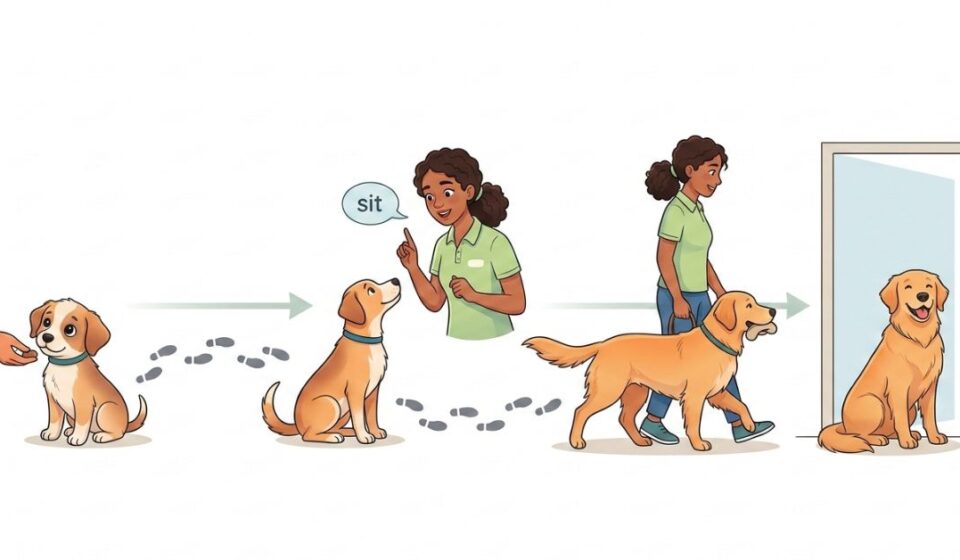

Every dog owner eventually asks the same pressing question: how long does it take to train a dog? The answer is rarely simple. Training is not a one time milestone but an evolving process shaped by age, temperament, environment, and the consistency of guidance. Some dogs respond within weeks, while others require months of structured reinforcement before reliable habits take hold.
Modern canine behavioral science has clarified one essential truth. Dogs learn through repetition, reinforcement, and emotional safety. According to the American Kennel Club and guidance from the American Veterinary Medical Association, consistent short sessions are significantly more effective than sporadic long sessions. This insight reframes expectations. Training is not about speed. It is about steady behavioral conditioning.
A realistic dog training timeline must account for developmental stages, cognitive capacity, and environmental variables. Puppies, adolescent dogs, and adult rescues all operate under different learning frameworks. When realistic dog training expectations replace impatience, progress becomes measurable and sustainable.
What Determines a Dog Training Timeline?
Age and Developmental Stage
Age remains the most influential factor in obedience training duration. Puppies between eight and sixteen weeks experience a heightened socialization window. During this stage, neural plasticity supports faster learning, especially for social cues and foundational commands.
Adult dogs can absolutely be trained successfully. However, training adult dog time may extend longer if previous habits are deeply ingrained. Behavior patterns reinforced over years require deliberate restructuring.
Breed and Genetic Traits
Certain breeds were historically developed for complex tasks. Herding dogs, working dogs, and retrievers often demonstrate high trainability due to selective breeding for responsiveness. Independent breeds may require additional repetition before commands become reliable.
Breed does not determine intelligence but influences motivation. Food driven dogs respond differently than dogs motivated by praise or activity.
Consistency and Frequency
Short sessions of ten to fifteen minutes performed daily yield better retention than irregular hour long sessions. Research from the Association of Professional Dog Trainers emphasizes repetition frequency over session length.
Consistency builds neural pathways. Inconsistent cues create confusion, which extends the overall dog training timeline.
Owner Skill and Clarity
Dogs respond to clear communication. Inconsistent tone, timing delays, and mixed signals prolong obedience training duration. Clear commands paired with immediate reinforcement significantly reduce training time.
Puppy Training Schedule: Week by Week Overview
Early training establishes the foundation for lifelong behavior. A structured puppy training schedule ensures gradual skill development.
Weeks 8 to 10: Foundation Phase
Focus areas:
- Name recognition
- Crate comfort
- Basic house training
- Introduction to sit command
House training during this phase may take two to four weeks with consistent supervision. Frequent outdoor breaks accelerate learning.
Weeks 10 to 16: Socialization Window
This is the most critical behavioral period. Exposure to controlled environments, sounds, and people builds confidence.
Key commands introduced:
- Sit
- Stay
- Come
- Leave it
Obedience reliability may take four to six weeks of daily reinforcement.
Months 4 to 6: Impulse Development
Adolescent behaviors begin emerging. Distraction increases. Reinforcement becomes essential.
Leash walking and recall often require several additional weeks to stabilize under distraction.
Months 6 to 12: Teenage Phase
This stage frequently tests realistic dog training expectations. Regression is common. Previously learned commands may appear forgotten due to hormonal shifts.
Continued structure during this stage prevents long term behavioral setbacks.
Training Adult Dog Time: What to Expect
Adult dogs are fully capable learners. However, previous conditioning shapes behavior patterns.
Newly Adopted Adult Dogs
Adjustment periods can last two to eight weeks. During this time, stress hormones may influence responsiveness. Gradual trust building precedes obedience refinement.
Rehomed or Rescue Dogs
Dogs with uncertain backgrounds may require longer stabilization. Basic obedience training duration often spans eight to twelve weeks for reliable consistency.
Previously Trained Dogs
Refresher training typically requires two to four weeks to reestablish command reliability.
The key distinction lies in habit restructuring. Repetition replaces older behavioral pathways with new ones.
Average Obedience Training Duration by Skill Level
The table below outlines general estimates. Individual variation is expected.
| Training Level | Average Timeframe | Reliability Expectation |
|---|---|---|
| Name Recognition | 1 to 2 weeks | High indoors |
| House Training | 2 to 8 weeks | Gradual improvement |
| Basic Commands | 4 to 6 weeks | Moderate reliability |
| Leash Walking | 4 to 8 weeks | Improved control |
| Recall Under Distraction | 8 to 12 weeks | Requires reinforcement |
| Advanced Obedience | 4 to 6 months | High reliability |
These timelines assume daily short sessions with positive reinforcement.
Why Some Dogs Learn Faster
Reinforcement Timing
Immediate reinforcement strengthens association. Delayed feedback weakens learning signals.
Motivation Matching
Food, praise, and play function differently across personalities. Matching reward type to motivation shortens training duration.
Low Stress Environment
Stress inhibits learning. Dogs trained in calm structured settings exhibit faster progress.
Clear Expectations
Realistic dog training expectations prevent frustration. Impatience often leads to inconsistent cues, extending the dog training timeline.
Common Misconceptions About Dog Training Time
Myth: Smart Dogs Train Instantly
Even highly intelligent breeds require repetition. Intelligence influences problem solving ability, not immediate obedience.
Myth: Adult Dogs Cannot Learn
Behavioral science confirms adult dogs retain learning capacity throughout life.
Myth: One Class Solves Everything
Group classes introduce skills, but daily reinforcement determines long term success.
Behavioral Science Behind Training Duration
Dogs learn through operant conditioning. Positive reinforcement increases behavior frequency when rewards follow actions. Neural reinforcement occurs through repetition and reward pairing.
Studies in applied animal behavior suggest consistent training for eight to twelve weeks builds reliable foundational obedience. However, maintenance remains lifelong.
Training is less about reaching an endpoint and more about reinforcing standards over time.
Realistic Dog Training Expectations
Expect gradual improvement rather than overnight transformation. Early progress often appears rapid, followed by plateaus. Plateaus represent consolidation periods where neural pathways stabilize.
Consistency during these phases determines whether training solidifies or regresses.
Training timelines also depend on:
- Household consistency
- Daily practice frequency
- Environmental distractions
- Emotional bond strength
Dogs trained with predictable structure show faster stabilization of behavior.
Signs Training Is Working
Observable indicators include:
- Faster response latency
- Reduced need for repetition
- Improved focus duration
- Lower distraction sensitivity
- Increased voluntary engagement
Progress should be measured weekly rather than daily to maintain perspective.
How to Shorten the Dog Training Timeline
Keep Sessions Short and Focused
Ten minute sessions repeated twice daily outperform sporadic long sessions.
Reinforce Calm Behavior
Rewarding calm states reduces impulsivity, accelerating obedience consistency.
Practice in Multiple Environments
Gradual exposure builds reliability beyond the home environment.
Maintain Predictable Commands
Use consistent verbal cues to prevent confusion.
When Training Takes Longer Than Expected
Extended obedience training duration may result from:
- Inconsistent reinforcement
- Excessive distractions
- Fear or anxiety responses
- Lack of clear boundaries
Patience and structured repetition remain the most effective corrective tools.
Lifelong Reinforcement
Training does not end once commands are learned. Behavioral maintenance prevents regression. Even well trained dogs benefit from periodic refreshers.
A realistic dog training timeline includes continuous reinforcement across the lifespan.
Conclusion
The question of how long does it take to train a dog does not have a universal answer. Timelines vary based on age, temperament, breed tendencies, and daily consistency. Puppies often establish foundational obedience within two to six months, while adult dogs may require structured eight to twelve week programs to stabilize behavior. Advanced reliability frequently extends across four to six months of reinforcement.
The most important factor is not speed but consistency. Dogs thrive under clear communication, predictable structure, and calm repetition. Realistic dog training expectations replace frustration with measurable progress. When daily practice becomes routine and reinforcement remains consistent, training evolves from a task into a shared language between human and dog. Sustainable obedience is built gradually, strengthened daily, and maintained for life.
Frequently Asked Questions
1. How long does it take to train a dog basic commands?
Basic commands typically require four to six weeks of daily short sessions for moderate reliability.
2. What is the average dog training timeline for puppies?
A puppy training schedule usually spans two to six months for foundational obedience.
3. Does training adult dog time take longer?
Adult dogs may require eight to twelve weeks to replace established habits, depending on prior training.
4. How long does house training take?
House training often takes two to eight weeks with consistent supervision and routine.
5. Can a dog be fully trained in one month?
Basic obedience may begin forming within one month, but full reliability usually requires additional reinforcement.
6. Why does obedience training duration vary so much?
Variation depends on age, consistency, environment, and individual temperament.
7. Do professional classes reduce training time?
Structured classes can accelerate progress, but daily home reinforcement remains essential.
8. Is older dog training possible after five years?
Yes. Adult dogs retain learning capacity throughout life with consistent repetition.
9. What slows down the dog training timeline?
Inconsistent commands, stress, and limited repetition commonly delay progress.
10. How long should daily training sessions last?
Ten to fifteen minutes per session, once or twice daily, supports effective learning without fatigue.